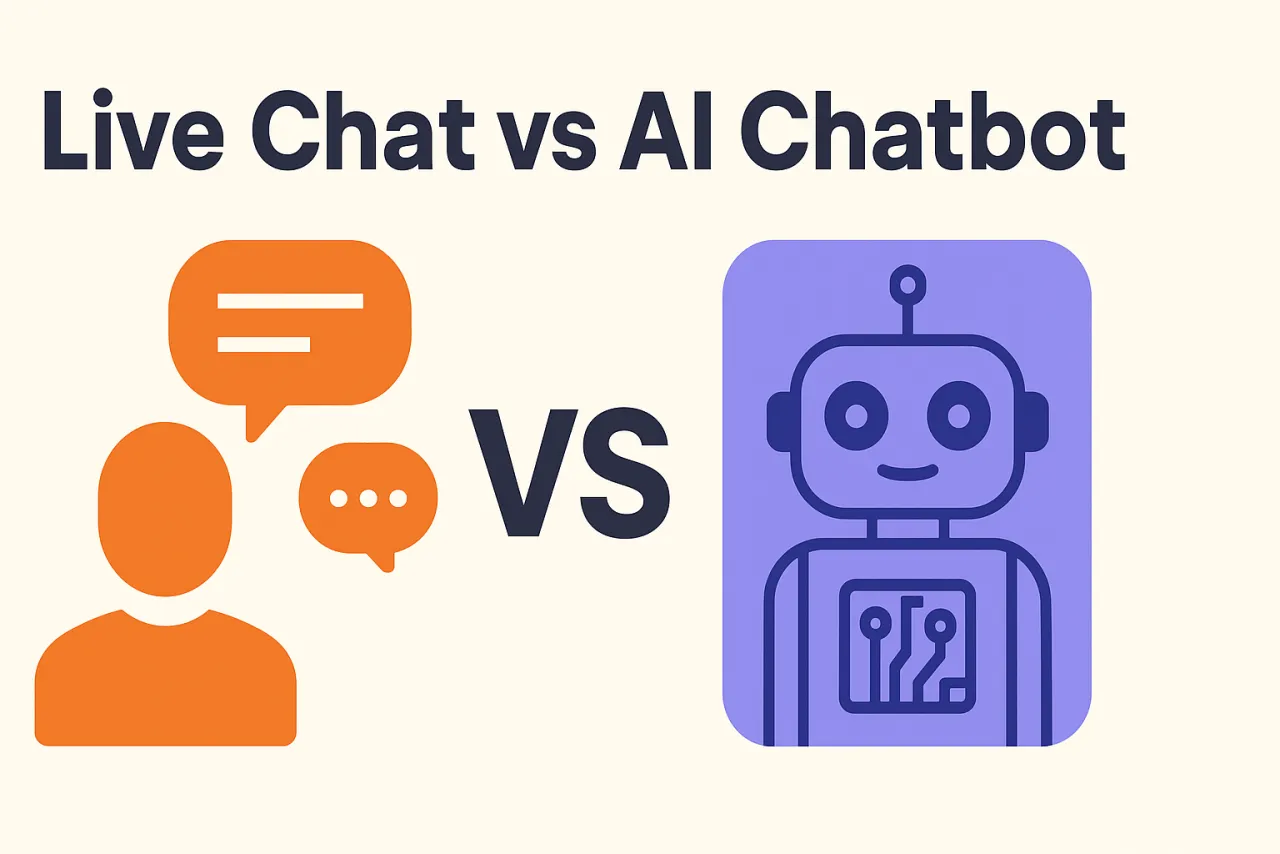
Live Chat vs. AI Chatbot — What's the Difference and How Do You Choose?
Live chat (human agents) and AI chatbots each have their place. This guide uses comparison tables and real-world scenarios to help you decide which to use — or how to combine both.
TL;DR — The two aren't competing: AI handles repetitive questions, humans handle conversations that require judgment and emotional awareness. Most teams with real traffic should use both together, not pick one. If you're handling fewer than 50 inquiries per day, human-only is fine.
Many teams face this question when setting up customer support: go with human live chat, an AI chatbot, or both?
The answer depends on your question types, not your preferences.
Core Differences
| Dimension | Live Chat (Human) | AI Chatbot |
|---|---|---|
| Response speed | Instant when online; no response when offline | Milliseconds, around the clock |
| Concurrent capacity | ~5–10 conversations per agent | Unlimited |
| Complex questions | Can judge, probe, look things up | Limited to knowledge base content |
| Emotional handling | Can recognize and adapt to emotions | Cannot detect emotional state |
| Operating cost | Scales linearly with headcount | One-time setup, near-zero marginal cost |
| Availability | Business hours | 24 hours × 7 days |
| Setup effort | Hiring and training agents | Configuring and maintaining knowledge base |
When You Need Human Agents
These conversation types will damage the user experience if handled by AI:
High-value sales conversations: A prospect asking "can we customize the enterprise contract?" before purchasing needs a human to judge, engage, and close the deal. Canned AI responses tend to kill interest in buyers who were ready to commit.
Complaints and refunds: Users are already upset. Robotic AI responses escalate the conflict. "Thank you for your feedback, it has been recorded" is completely ineffective with an angry customer.
Cross-system operations: Checking order status, processing refunds manually, adjusting account permissions — anything requiring actual backend actions that AI cannot perform.
Ambiguous questions: "I have a somewhat unusual situation..." — when users can't even clearly describe their own problem, a human needs to ask follow-up questions to understand the real need.
When AI Is Clearly Better
These scenarios make human handling a waste of resources:
High-frequency repetitive inquiries: Password resets, business hours, delivery coverage, payment methods — questions like these typically make up 50–70% of total inquiry volume, and every single one has a fixed answer.
Nights and holidays: A visitor submits a question at 2 AM. AI picks it up, logs the issue, and a human follows up when back online. Always better than no response at all.
Promotional peaks: Inquiry volume during a major sale can be 5–10× normal. You can't staff up fast enough — AI is the only solution that can absorb peak traffic smoothly.
Standard guided flows: New user onboarding, common troubleshooting steps — structured flows with fixed paths are executed more consistently by AI than by humans, without quality varying based on agent mood.
Using Both Together: The Standard Approach
Most real businesses are hybrid — they have high-frequency repetitive questions and complex questions requiring judgment. The industry's accepted best practice is AI handles first contact → escalates to human when it can't resolve:
Visitor starts a conversation
    ↓
AI matches knowledge base
    ↓
Match found → auto-reply, conversation ends
No match → one-click transfer to human agent
    ↓
Human takes over and handles the rest
In practice: AI automatically handles repetitive high-frequency inquiries; human agents only receive conversations that genuinely require judgment. For visitors, response is faster. For the support team, work quality is higher.
A newly launched knowledge base typically lets AI auto-handle 20–30% of inquiries. After 4–6 weeks of iterative improvement, it can stabilize at 60%+.
How to Choose
Lead with human agents if:
- High average order value (above $500), with long customer decision cycles
- Your question types are highly varied, with almost no standard answers
- The core business depends on sales conversion, not technical support
Lead with AI if:
- Simple product, with 80%+ of questions having fixed answers
- Team of 1–2, unable to be available around the clock
- Inquiry volume is concentrated in off-hours or specific peak periods like promotions
Use both together if:
- You have steady inquiry volume with a mix of question types
- Team of 3+, with clear active service hours and coverage gaps
- You want both service quality and cost control
If you're handling fewer than 200 inquiries per month, don't bring in AI yet — human-only is simpler with less configuration complexity.
FAQ
Will AI give users a bad experience?
Poorly configured AI will. The two key factors: the knowledge base must cover real high-frequency questions, and the handoff to humans must be smooth. When AI can't answer, immediately offer a "talk to a human" option — don't keep serving unrelated template responses. Well-designed AI + human escalation typically results in shorter wait times than a purely human queue.
How long does it take to "train" the AI?
Basic FAQ configuration takes 1–2 days. Reaching a stable automation rate (handling 60%+ of conversations on its own) typically takes 4–6 weeks of iteration: launch → review unmatched logs → expand knowledge base → re-launch. Don't aim for perfection before launch — real user conversations are your best optimization data.
Can one system support both modes?
Yes. Major live chat platforms integrate both in a single system, with AI and human agents sharing the same conversation history and management dashboard — no need to deploy two separate tools.
What's the difference between a chatbot and an AI customer service agent?
Essentially the same thing. "Chatbot" emphasizes automation; "AI customer service" emphasizes AI understanding capability. In actual products, both terms usually refer to the same module: an auto-reply system based on a knowledge base and semantic matching.
Qiabot includes both an AI knowledge base bot and human live chat with seamless handoff. After signing up, you can configure the AI first, then decide whether to add seats based on actual results once the knowledge base stabilizes.